
Absolutely Essential Aromatics:
- Deborah Casey
- 17 hours ago
- 4 min read
How to Create Your First Essential Oil Blend (Without Overthinking It)

You’ve smelled the oils.You’ve fallen in love with at least one of them. You’ve perhaps become slightly evangelical about lavender before bed and sweet orange in the kitchen.
And then, inevitably, the thought arrives:
Could I make my own blend?
The answer is yes.And perhaps more importantly: you do not need to make it complicated.
Because while the world of aromatherapy can absolutely become rich, layered, and wonderfully detailed, your very first blend does not need to resemble a Victorian apothecary experiment or require seventeen bottles, a spreadsheet, and a mild identity crisis.
Your first blend only needs to do one thing well:
create a feeling.
That’s it.
Not impress.Not perform.Not become your aromatic magnum opus.
Just create a feeling you want more of.
And honestly, that is where the best blending begins.
Aromatherapy blending is less chemistry panic, more sensory storytelling
People often assume blending is about getting everything “right” in a technical sense.
And yes, safe ratios and thoughtful choices absolutely matter — we’ll come to that. But before all of that, blending is really about asking a much more beautiful question:
What do I want this to feel like?
Do you want calm?Freshness?Morning energy?Evening softness?A cleaner-feeling room?A little more emotional steadiness in the middle of a chaotic week?
A blend is simply a way of creating that atmosphere on purpose.
In other words, you are not just mixing oils.You are creating a mood, ritual, or aromatic intention.
And that is infinitely more interesting.
Step One: Choose your purpose before your oils
Before opening bottles like an overexcited botanical alchemist, decide what your blend is for.
A beginner blend is easiest when it has a simple emotional or practical theme.
For example:
Calm and unwind
Fresh and focused
Light and uplifting
Comfort and rest
Clean and clear atmosphere
Once you know the feeling, the oils become much easier to choose.
Because the best blends are not random.They have a personality.
Step Two: Start with just 2 or 3 essential oils
This is where beginners often go gloriously wrong.
They get excited.They add six oils.Then another two “for complexity.”Then something floral enters the room uninvited and suddenly the whole thing smells like a confused spa gift basket.
Resist this.
Your first blend should be beautifully simple.
Choose two or three oils maximum.
That gives you enough depth to create something interesting without tipping into aromatic chaos. Here are a few easy beginner pairings:
For Calm
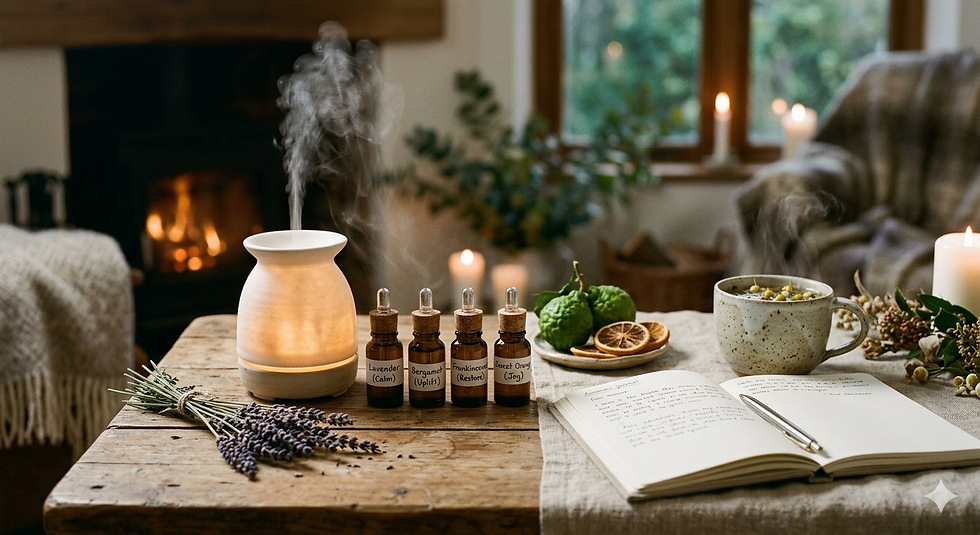
Lavender + Sweet Orange
Soft, comforting, and beautifully easy to live with.
For Focus
Peppermint + Lemon
Bright, fresh, mentally clarifying, and ideal for daytime use.
For Grounding
Frankincense + Lavender
Quiet, thoughtful, centring, and perfect for stillness or reflection.
For Freshness
Eucalyptus + Sweet Orange
Clean, bright, and wonderfully uplifting for the home.
Notice how each pairing has a different emotional tone.
That is the real art of blending.
Step Three: Use the “drop by drop” method
If you are blending for a diffuser or room aroma experiment, keep it delightfully simple.
Take your chosen oils and start small.
For example:
2 drops lavender
2 drops sweet orange
Or:
2 drops peppermint
1 drop lemon
Then inhale gently and ask:
What do I notice first?
Is one oil dominating too much?
Does this feel balanced?
Does this actually create the feeling I wanted?
This is where blending becomes less “recipe-following” and more relationship-building.
Sometimes a blend needs brightness.Sometimes it needs softness.Sometimes it simply needs one less drop of whatever just took over the room like it pays rent.
Step Four: Remember that scent changes in space
A blend might smell one way in the bottle and another way once diffused into a room or added into a broader ritual.
This is important.
Some oils bloom beautifully in the air.Others become stronger, sharper, sweeter, or heavier than expected.
Which means your first blend does not need to be perfect immediately.
It simply needs to be tested, noticed, and adjusted.
That is not failure.That is blending.
A very important word about safety
This is where we keep the magic, but also keep our common sense.
Essential oils are highly concentrated plant extracts and should always be used responsibly.
A few beginner rules worth keeping close:
Do not apply neat essential oils directly to the skin unless you are appropriately trained and know they are safe to do so
If making a topical blend, always use a suitable carrier oil such as sweet almond, jojoba, or grapeseed
Label your blends clearly
Keep oils away from children, pets, eyes, and sensitive areas
Some oils are not suitable in certain circumstances, so always research before use
Aromatherapy is most beautiful when it is both creative and careful.
Blending is part intuition, part listening
One of the most rewarding things about aromatherapy is that over time, you begin to trust your senses more.
You notice what calms you.What sharpens you.What feels too sweet, too strong, too sleepy, too “absolutely not today.”
That is not trivial knowledge.That is personal aromatic literacy.
And once you begin to develop it, your blends become less about copying what everyone else is doing and more about creating what genuinely supports you.
That is where your confidence grows.
Not in getting everything technically flawless.But in becoming more attentive.
Your first blending invitation
This week, create one tiny beginner blend using just two oils. Choose a purpose:
calm
clarity
comfort
uplift
Then test it slowly.
Write down:
which oils you used
how many drops
what it smelled like
how it made the room or moment feel
Because that is how your aromatherapy practice becomes richer.
Not by collecting more.But by noticing more.
And really, that may be one of the most essential lessons in aromatherapy of all.
Not just:
What does this smell like?
But:
What does this create?
And when a scent creates calm, lightness, softness, steadiness, or a moment of genuine pause in the middle of modern life…
That is not a small thing.
That is absolutely essential.
Coming Next in the Absolutely Essential Aromatics Series
How to Bring Aromatherapy Into Everyday Life Without Turning Your House Into a Wellness Theme Park
Ready to go beyond the basics?Explore my accessible aromatherapy and holistic wellbeing learning resources designed to help you build confidence, deepen your knowledge, and enjoy a more natural, sensory approach to everyday wellbeing.


Comments