
Absolutely Essential Aromatics
- Deborah Casey
- 19 hours ago
- 4 min read
Aromatherapy for Mood, Mind, and Emotional Wellbeing
The mind feels crowded. The nervous system feels prickly. The body is technically sitting still, but internally there are seventeen tabs open, three emotional weather systems moving through, and a low-level hum of “I need to sort my life out” playing somewhere in the background.
And this is often where aromatherapy quietly earns its place.
Not because essential oils can magically erase stress, sadness, overwhelm, or mental fatigue — they can’t, and they should never be presented as a cure-all. But because scent has an extraordinary ability to shift atmosphere, influence feeling, and gently interrupt emotional autopilot.
Sometimes that is enough to change the texture of a moment.
And sometimes, that is exactly what we need.
Why scent affects mood so powerfully
Scent is not a distant sense. It is immediate, intimate, and deeply personal.
Before we have fully formed thoughts about a fragrance, we have often already felt it. A smell can soothe, energise, irritate, comfort, uplift, or transport us before we have even decided whether we “like” it.
That is what makes aromatherapy so fascinating for emotional wellbeing.
Unlike many forms of self-care that require time, planning, money, or motivation you may not currently possess, scent can work in the smallest of ways. A diffuser in the corner. A steam inhalation. A scented pause before bed. A few intentional breaths before you answer the email you absolutely did not ask the universe for.
It is subtle. But subtle does not mean insignificant.
Aromatherapy as emotional atmosphere
One of the most useful ways to think about aromatherapy is not as “fixing” emotion, but as supporting emotional atmosphere.
In the same way lighting, music, temperature, and environment affect how we feel, scent can help shape the inner and outer tone of a space.
You might use aromatherapy to create more:
calm
clarity
comfort
steadiness
softness
uplift
focus
emotional reset
This is not about perfection. It is about creating tiny, sensory conditions that make wellbeing feel a little more possible.
And frankly, that is often more realistic — and more powerful — than the grand, unrealistic wellness routines people are forever trying to sell us.
Essential oils often associated with mood and mind
While everyone responds differently to scent, there are certain essential oils people often gravitate towards when they want emotional support or mental clarity.
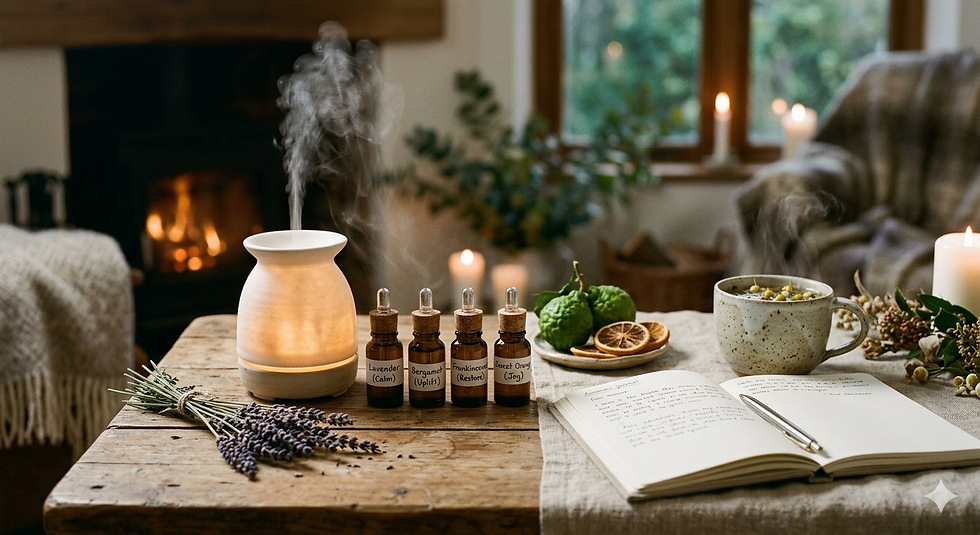
Lavender – for softening and slowing
Lavender is often associated with emotional comfort, evening calm, and helping the atmosphere feel less sharp around the edges. It is ideal when the day has felt loud.
Sweet Orange – for lightness and lift
Bright, warm, and quietly cheerful, sweet orange is often chosen when things feel heavy, flat, or emotionally stale. It can bring a sense of freshness and warmth into a room.
Frankincense – for stillness and grounding
There is something deeply centring about frankincense. It is often used during prayer, meditation, journaling, and reflective practices because it tends to create a slower, more anchored mood.
Peppermint – for mental clarity
When the mind feels sluggish, cluttered, or half asleep, peppermint can bring a cooling sense of alertness and refreshment.
Bergamot – for emotional brightness
Elegant, citrusy, and slightly floral, bergamot is often loved for its balancing, mood-friendly quality. It feels sophisticated and emotionally spacious.
The trick is not to memorise what each oil is “for” like you are cramming for an aromatic exam.
The trick is to notice:What does this scent do to me?
That question matters more than any chart.
Creating aromatic rituals for emotional wellbeing
Aromatherapy becomes most powerful when it is woven into small, repeatable rituals.
Not occasional panic-buying.Not dramatic reinvention.Not wellness theatre.
Ritual.
That might look like:
Morning clarity
Diffuse peppermint, lemon, or sweet orange while getting ready for the day to create a fresher, more awake atmosphere.
Midday reset
Pause for one minute. Inhale a scent that feels grounding or uplifting. Let it interrupt the pace before the day swallows you whole.
Evening decompression
Diffuse lavender, frankincense, or another calming oil as a signal that the day is beginning to close.
Emotional anchoring
Choose one “support scent” and use it consistently during journaling, reflection, rest, or quiet moments. Over time, the body often begins to associate that aroma with safety, calm, or pause.
This is one of the most beautiful things about aromatherapy:it can become a language of self-support.
A gentle word of realism
Aromatherapy can be a wonderful companion for emotional wellbeing, but it is not a replacement for professional mental health support, medical care, or therapeutic intervention where needed.
It can support.It can soothe.It can comfort.It can create emotional breathing space.
But it should always be approached honestly, respectfully, and without exaggerated promises.
That is part of using aromatherapy wisely.
Your aromatic mood invitation
Here is a simple practice to try this week:
Choose one essential oil and use it intentionally for three consecutive days.
Each time you smell it, ask yourself:
How do I feel before I inhale this?
How do I feel after?
Does this scent soften me, sharpen me, settle me, or lift me?
Do I want more of this feeling in my life?
You may be surprised by how much a single scent can reveal.
Because aromatherapy is not only about plants, properties, and practical use.
It is also about attention.
And in a world that constantly pulls us away from ourselves, there is something quietly radical about returning to the senses and asking:
What helps me feel more like me again?
That is not frivolous.That is not indulgent.That is not “just a smell.”
That is wellbeing with depth.
And yes — it is absolutely essential.
Coming Next in the Absolutely Essential Aromatics Series
Aromatherapy for Everyday Physical Comfort and Home Wellbeing
Do you want to explore aromatherapy more deeply in a grounded, practical, and inspiring way?
Explore my holistic online learning resources and beginner-friendly aromatherapy education designed to make natural wellbeing feel more accessible, enjoyable, and real.


Comments